
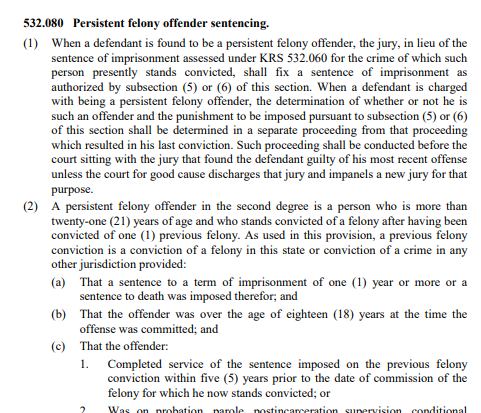
Many criminal defendants face enhanced punishments because of having prior convictions. These enhancements mean that otherwise minor felony offenses become very serious. In Kentucky, the punishments for felony criminal offenses (other than drug possession) can be enhanced under the Persistent Felony Offender statute if you have certain qualifying priors.
To be a Persistent Felony Offender in the Second Degree, the offender must be:
- 21 years of age
- Have at least 1 previous felony
- The term of punishment imposed was one year or more (regardless of whether the sentence was probated)
- The offender was 18 or older at the time of the offense
- And the prior offense, incarceration, or term of probation/parole ended within the past 5 years.
To be a Persistent Felony Offender in the First Degree, requires the same proof as Persistent Felony Offender in the Second Degree, with the added requirement that a second felony conviction exist which satisfied prongs 1-4, and was not served concurrently or in uninterrupted consecutive terms with the other predicate felony. Simply put, a criminal defendant who has two prior felony convictions that were separate in time in, with one of those priors completed within the past 5 years, would be eligible to be found to be a Persistent Felony Offender in the First Degree.
A Persistent Felony Offender (“PFO”) designation can have huge implications for a criminal defendant. A Class D Felony usually carries a range of punishment of 1-5 years . A PFO 2nd enhancement would increase that to 5-10 years. And a PFO 1st enhancement would increase that range of punishment from 10-20 years.
The implications get more severe for Class C Felonies. The usual range of punishment for Class C Felonies is 5-10 years, but a PFO 2nd enhancement would increase the range to 10-20 years. A PFO 1st charge keeps the range of punishment at 10-20, but requires anyone convicted of a Class C Felony and PFO 1st to serve at least 10 years, day-for-day, before being parole eligible. Parole eligibility is usually 20% so this is massive increase.
In practice, the threat of a PFO indictment is usually accompanied with a plea offer. And the risk to the defendant of proceeding to trial is being convicted of both the underlying felony charge and then the PFO enhancement. This drastically changes what cases go to trial, since many defendants are too scared of the enhancement to take otherwise defensible cases to trial.
If a defendant charged with a PFO enhancement is convicted at trial of an underlying felony offense, a jury will have to find them guilty of PFO to increase the punishment. This may sound good in theory, but in practice courts have severely limited the abilities of defense counsel to argue for a not guilty verdict on the PFO count. Defense attorneys are not permitted to ask the jury to nullify or disregard the PFO law if it lead to an unjust or disproportionate sentence.
Criminal defendants with prior felony convictions charged in Kentucky need to be informed about the PFO statute and how it affects their range of punishment and parole options. This statute punishes otherwise minor felony offenses very harshly. If you are charged with a crime that could be enhanced by PFO, it is essential that you have an experience attorney to help you navigate these treacherous waters.